
By Charlie Adams
Custom Connect: Director of Customer Experience and Success
The Institute of Customer Service UK Customer Satisfaction Index (UKCSI) has been published and, on the surface at least, it’s a cautiously optimistic read.
The headline number is up. The January 2026 UKCSI sits at 78.2/100, a 2.1-point increase year-on-year, and the highest score since July 2022. Every single sector has improved compared to last year, with particularly strong gains in Public Services (Local), Services, Transport, and Utilities.
So yes, something is improving. But as ever with UKCSI, the more interesting story sits beneath the average.
In this first edition for 2026, Director of Customer Experience and Success, Charlie Adams, gives his review of the latest UKCSI report – are things really getting better?
A tale of two realities: confidence vs. care
One of the most striking themes in the latest ICS report is the disconnect between personal and national confidence.
- 42.6% of customers believe their own financial situation will improve in the next 12 months
- But only 31.1% feel the same about the UK economy
Customers may feel personally resilient, but they remain cautious about the wider environment. That matters for customer experience teams, because confidence and satisfaction are closely linked. When people feel secure, they are more open to loyalty, advocacy, and even paying more for better service.
At the same time, there’s a clear uplift in how customers feel treated:
- 64.1% of customers felt organisations understood and responded to their personal needs (up 4.3 points)
- 68.8% felt that organisations genuinely care about them (up 4.7 points)
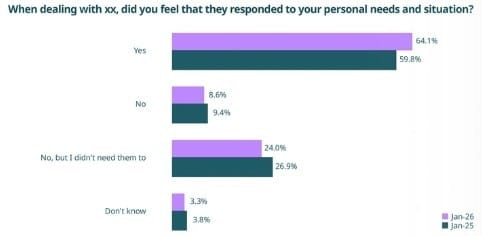
These small shifts point to organisations getting better at demonstrating empathy, personalisation, and responsiveness, whether through better training, smarter processes, or improved technology.
However, this progress isn’t evenly felt. Customers with poor or very poor financial well-being are still far less likely to feel understood or cared for. That’s a critical ethical and commercial challenge: how do we design service models that are both efficient and genuinely inclusive?
Right first time still matters more than almost anything
If there is one metric that should keep every operations and QA leader awake at night, it’s this: Customers who felt understood scored their experience at 82.8, versus just 51.0 for those who didn’t.
That 31-point gap is enormous.
The report reinforces what many in BPO and contact centre leadership already know: “right first time” experiences and effective complaint handling remain the biggest differentiators between top performers and everyone else.

For high-performing organisations (top 50 vs. the rest), the gaps are stark:
- Higher “right first time” rates
- Fewer customer problems
- Stronger emotional connection
- Better complaint handling scores
From a BPO perspective, this is where quality assurance (QA) and coaching technology becomes mission-critical. The organisations winning here aren’t just hiring nicer people, but they’re systematically identifying failure points, coaching in the flow of work, and using data to prevent repeat issues.
Customers are willing to pay for better service, but only if they trust you
Perhaps the most commercially significant finding in this UKCSI is the continued rise in customers who prefer excellent service, even if it costs more.
- 35.6% now say they would pay more for premium service – up 4.3 points in a year, and nearly 10 points since 2020.
The why is just as important:
- Trust is now the number one reason people are willing to pay more
- Followed by a desire for support/advice
- And confidence they’ll get the right product or service
This is a powerful signal to brands: price alone is no longer enough. Trust, consistency, and competence are becoming competitive advantages.

When asked what they would pay extra for, customers prioritised:
- Speed and convenience
- More personalised service
- Easy access to human advisors
That’s a balancing act between automation and humanity; exactly where BPOs and AI-enabled QA tools can add real value.
Where AI actually fits (and where it doesn’t)
The report’s recommendations explicitly call out “Harnessing Artificial Intelligence.” Importantly, this isn’t about replacing advisors with chatbots at all costs. Instead, the focus is on using AI to:
- Improve analytics and decision-making
- Reduce inefficiency in processes
- Streamline logistics and information flows
- Free up human capacity to focus on complex, high-value interactions
From a QA technology standpoint, this is where modern platforms can make a tangible difference:
- AI-assisted call and interaction analysis to spot patterns at scale
- Automated quality scoring to reduce manual workload
- Smart coaching prompts that trigger in real time when performance dips
- Predictive insights that help leaders intervene before problems escalate
In a BPO world, this is less about “AI vs. people” and more about AI that helps people be better, faster, and more consistent.
AI in Contact Centres: Empowerment, Not Elimination – Contact Centre Monthly
Are things really getting better?
The real answer: yes, but unevenly.
Better:
- Overall satisfaction is up
- More customers feel cared for
- More people value excellent service
- Complaint handling scores have improved
- Right-first-time performance is trending positively
Challenges:
- Vulnerable customers still feel underserved
- Sector performance varies widely
- Trust is fragile in an era of misinformation and AI-generated content
- Customers expect both efficiency and empathy
Where companies need to focus to win in the future
Based on this UKCSI, the organisations that will pull ahead will likely be those that excel in five areas:
- Personalised care at scale – using data and AI to understand customers without feeling intrusive.
- Right-first-time performance – fewer problems, better resolutions, stronger QA frameworks.
- Smart AI adoption – focusing on analytics, automation, and decision support rather than blunt cost-cutting.
- Workforce engagement – because engaged employees deliver better experiences.
- Trust and transparency – especially in how data, AI, and customer interactions are handled.
For those of us working in BPO, CX, and QA technology, this latest report reinforces what many of us have believed for years: the future of great service isn’t just human, and it isn’t just digital. It’s the intelligent (and purposeful) combination of both.